Études
Obsolete social necessity is what upholds all practices, while also making them “obscure to the eyes of their producers” [1], or at least this is the case for sociologist Pierre Bourdieu who—in a chapter from The Logic of Practice titled “Belief and The Body”—states that what causes practice is precisely these enacted beliefs converted into the motor schemes and body automatisms that plague us.
A listening “practice” is, like any other practice, a quasi-bodily manifestation of this obsolete social necessity, whereas listening without practice is a situation that has the potential to catapult our sensibilities into the sublime. In other words, listening without practice—if such a thing is even attainable—can be used to expose what has since been obscured by practice in the eyes (or ears) of its producer.
We often witness this in the practice of speaking, where for instance in the performance of a psychoanalytic session, the analysand’s speech is more often than not responded to by the analyst with either repetition, affirmation (“yes”, “oui”, “si”, “ja”, …), or complete silence [2]. This response—or lack thereof—is thought to cause a certain rupture in the analysand’s relationship with the words they use, in which they must confront the symptoms that naturally arise out of the practice that underlies speech. What subsequently transpires is a very particular situation for listening that transcends practice: a listening in which, simply with the presence of an other, the analysand is finally able to direct their audition towards how their use of language is symptomatically contingent on practice.
Most importantly, this obliterates the analysand’s false conviction that they speak using a language of their own.
And yet, musicians and artists alike cling to the notion of “practice” despite the ahistoricity, nostalgia, and reactionary mythos it perpetually confirms. So what then do we mean when we talk about a “musical practice,” and why do we feel as though a practice must be constructed, especially if such a thing inevitably dissolves into a myriad of socially meaningless impulses? Perhaps it provides us with a misleading but nonetheless comforting conviction that is precisely analogous to that of the analysand: that the music and art we produce belongs to us and not to an other.
On the contrary, what we think of as our own actually belongs to no one. I’ve created this ongoing series of études with the intention of developing techniques that undermine this very illusion, which often remains dormant—inscribed onto the body by way of practice. The common thread throughout these exercises is the exploitation of different types of social mediation that are at work during the act of musical listening. Indeed, the things that we believe are meaningless often carry the most meaning in terms of how we listen, and thus it is necessary to interpret the setting for musical listening much like we interpret everyday life—that is to say, we must interpret it like a dream. Those willing to recreate or reinterpret these exercises are encouraged to do so.
[1] - Pierre Bourdieu, The Logic of Practice, trans. Richard Nice (Stanford, CA: Stanford University Press, 1990), 68–69.
[2] - Here I’m specifically referring to Lacanian analysis, but this phenomenon of course takes place in other analytic settings.
I.
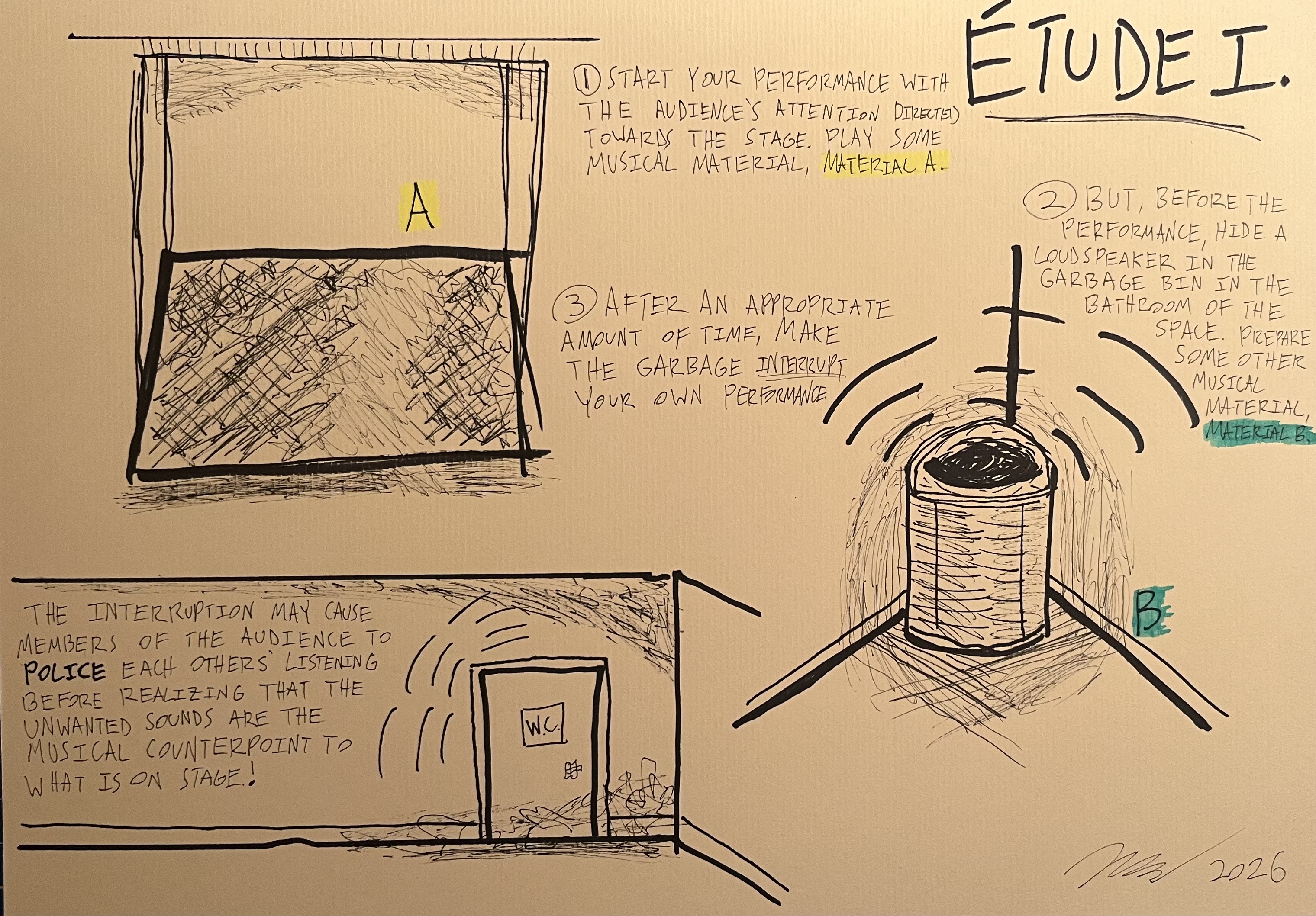
Documentation
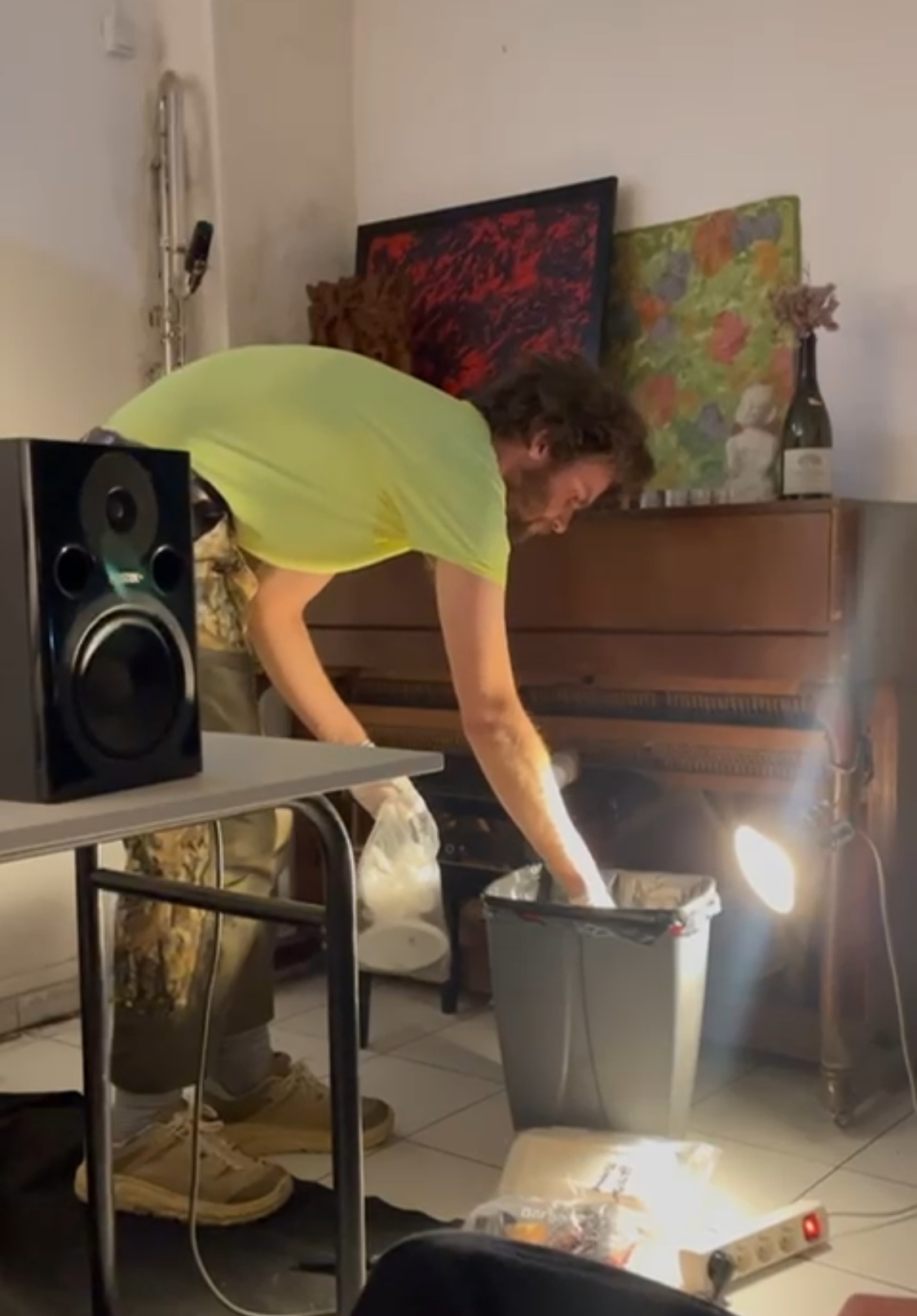
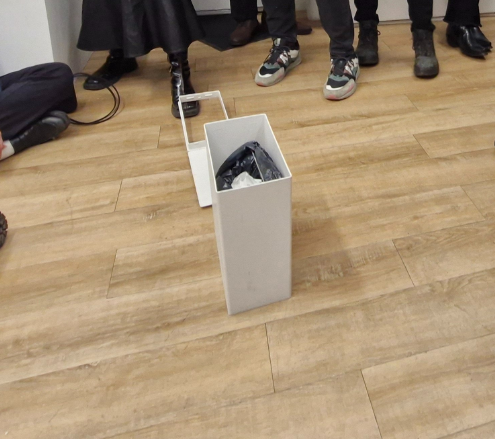
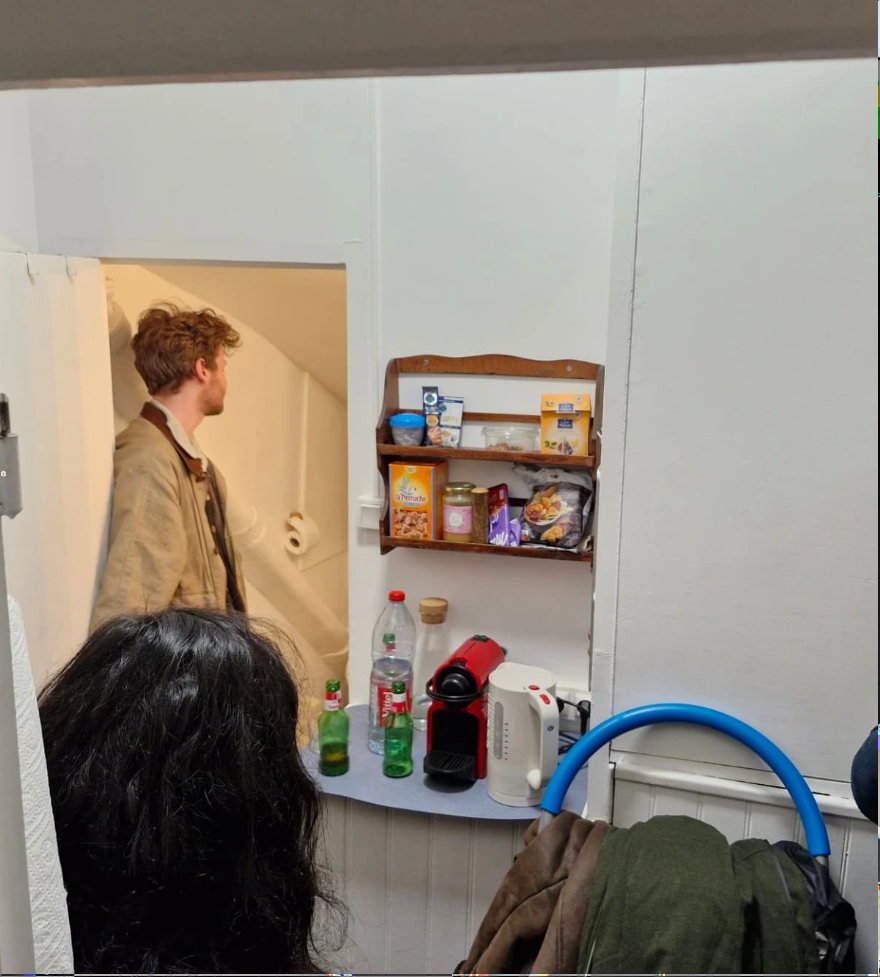
Étude I. was first premiered at Tiasci (Paris, FR) on December 10th, 2024. Another iteration was then premiered at 15 Rue Beautrellis (Paris, FR) on February 17th, 2025.
II.
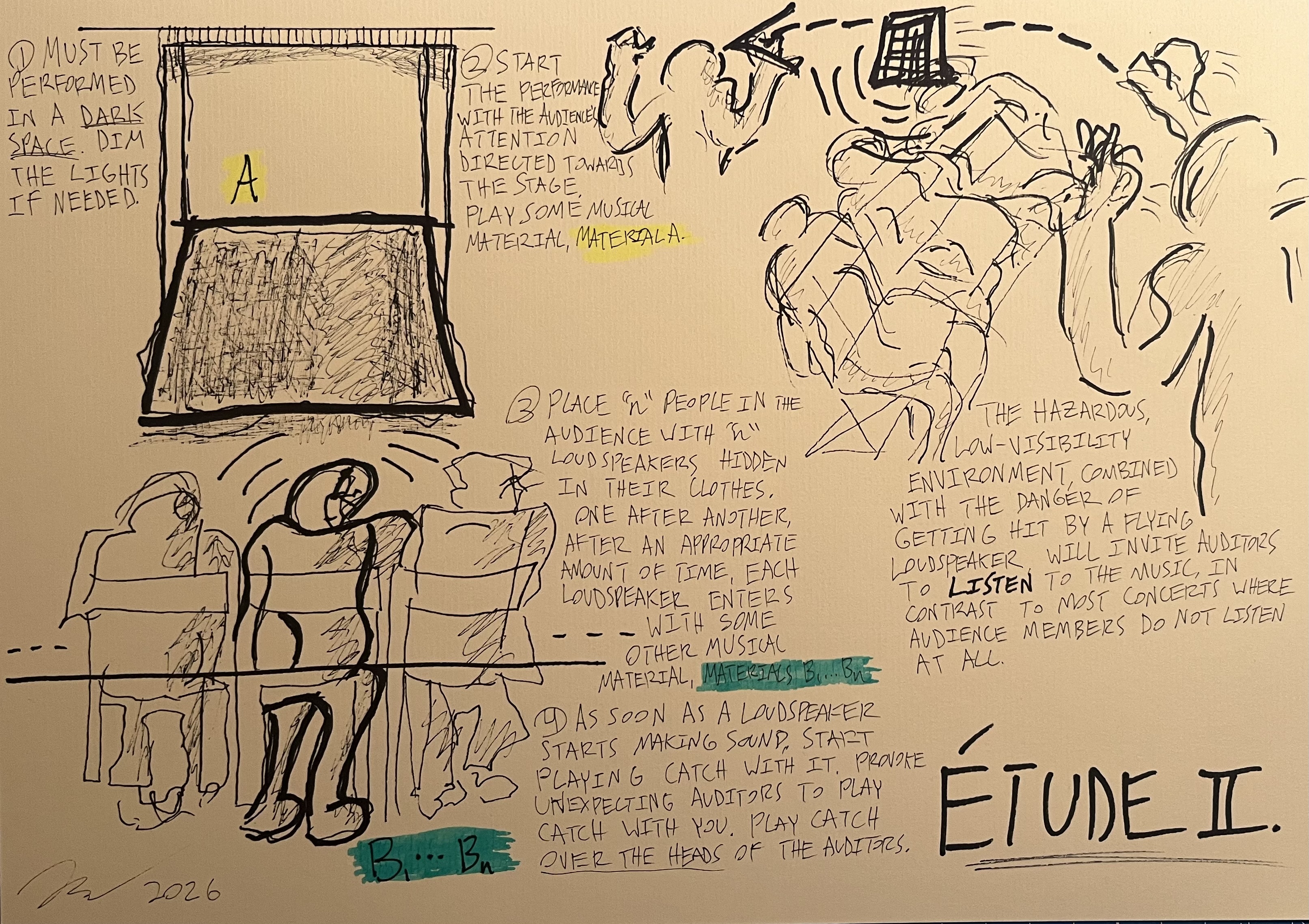
Documentation
Étude II. was first premiered at Casa del Popolo (Montréal, QC) on January 7th, 2025. It was performed by Selin Altuntur, Hannah Blair, Hannah Ferguson, Sara Provencher, and Ezra Teboul.
III.
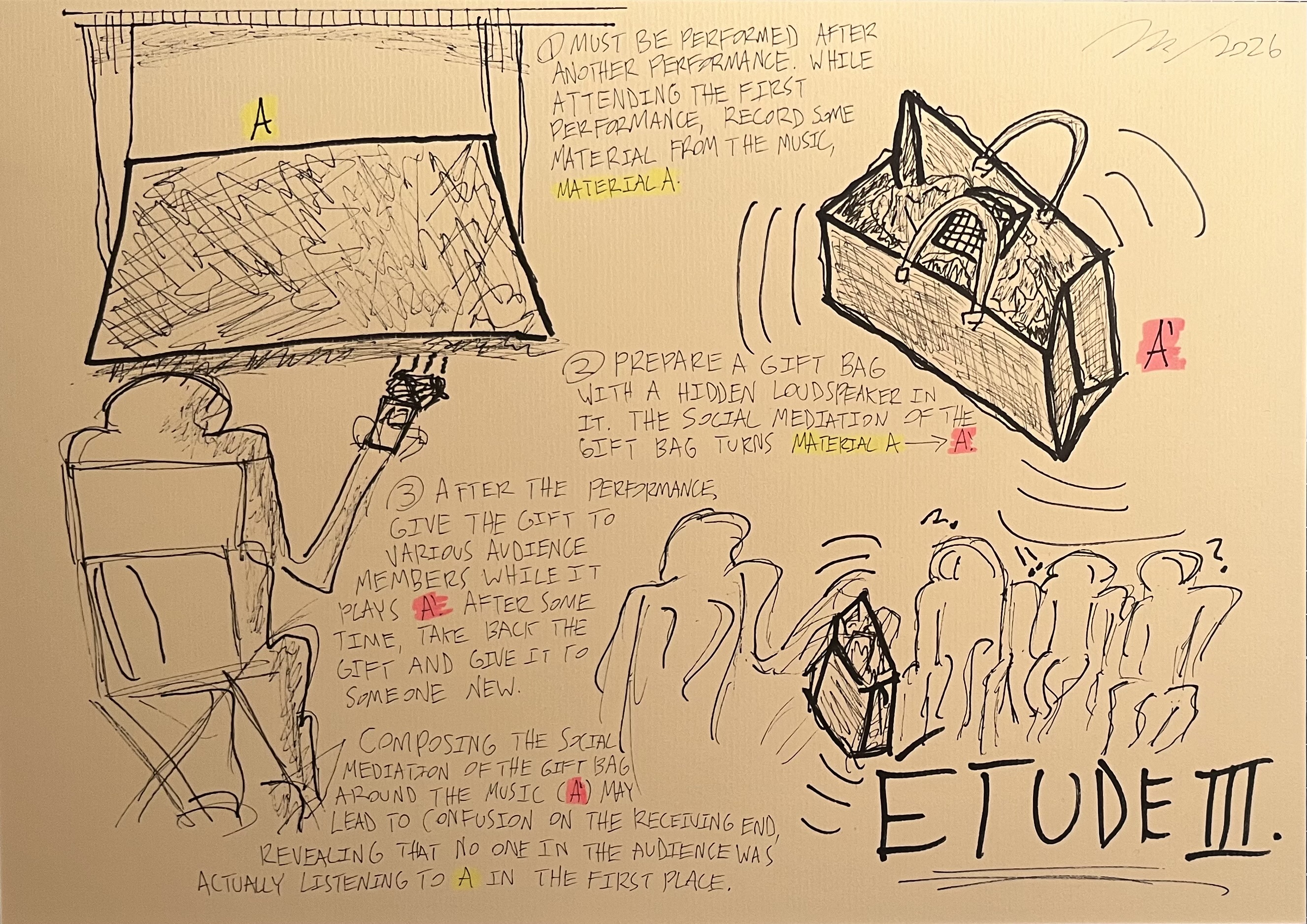
Documentation
Étude III. was first premiered at CuteLab (Brooklyn, NY) on December 27th, 2024, in collaboration with Dominic Coles.